

Landscape stories
The landscape has good memory and narrates itself. Interpreters of this tales: land reclamation, river floods and the breaking of banks, marshy expanses of water, hydraulic constructions to regulate and channel river water, land that advances or retreats.
Today, the Codigo landscape is characterised by long fields at the bottom of which are lost the streets and canals cutting through the land and vertical elements consisting of poles and pillars, trees, cranes and chimneys. All of this is the result of man’s land reclamation work, which for centuries has sought to take land away from the waters and has left, scattered throughout the area, clearly visible evidence that today constitutes examples of industrial archaeology.
After a phase of relative hydrographic stability in the ancient and early medieval ages, the system came into crisis with the Ficarolo routes of 1152 which, by shifting the main course of the Po to the north, made the Po di Volano a secondary branch of the Delta and caused the silting up of the canals and the extension of marshy areas that were hotbeds of malaria.
The first attempt at reclamation was made in 1464 by Borso d’Este. However, it was Alfonso II who initiated the first major land reclamation in 1564, with the active participation of the famous Ferrara architect and hydrostatic expert Giovanni Battista Aleotti.
The territory between the Volano river to the south and the Po Grande river to the north was in fact divided into two areas: on the one hand the “old lands“, higher and more cultivated, and on the other hand the depressions, submerged for most of the year and with reeds and peat bogs. In order to conquer these lands for agriculture, it was decided to build large collector canals to convey the water to the sea: to the north the Po dell’Abate received the high waters, to the south the Po di Volano the low waters, and piles were built with culverts at their outlet to the sea.
The work was completed in 1580 but the piles were swept out to sea, the Abate weir was blocked by debris and the Volano weir was destroyed. The Serenissima also cut Porto Viro in order to save its lagoon, making the Po di Levante flow further south and compromising the flow of water in the canals.
At the end of the 17th century the waters of the southern canals were led to the sea through the Chiavica dell’Agrifoglio, located further inland on a wide bend of the Po di Volano. The building is perhaps one of the oldest hydraulic structures in the Province of Ferrara, still in existence but no longer usable due to the draining of the Valle Giralda and the Volano bend in the open countryside near the Pomposa Abbey by the most recent mechanical reclamation: a masonry construction with a rectangular body, a pitched roof and a longitudinal walkway accessed through arched entrances, with seven large rectangular windows on the southern elevation while the northern elevation has none. The manhole consists of 8 basins (4 larger ones on the west side and the same number of smaller ones on the east side), surmounted by terracotta barrel vaults resting on wedge-shaped pillars, some of which preserve part of the vertical wooden bulkheads and the supporting elements made from blocks of Istrian stone.
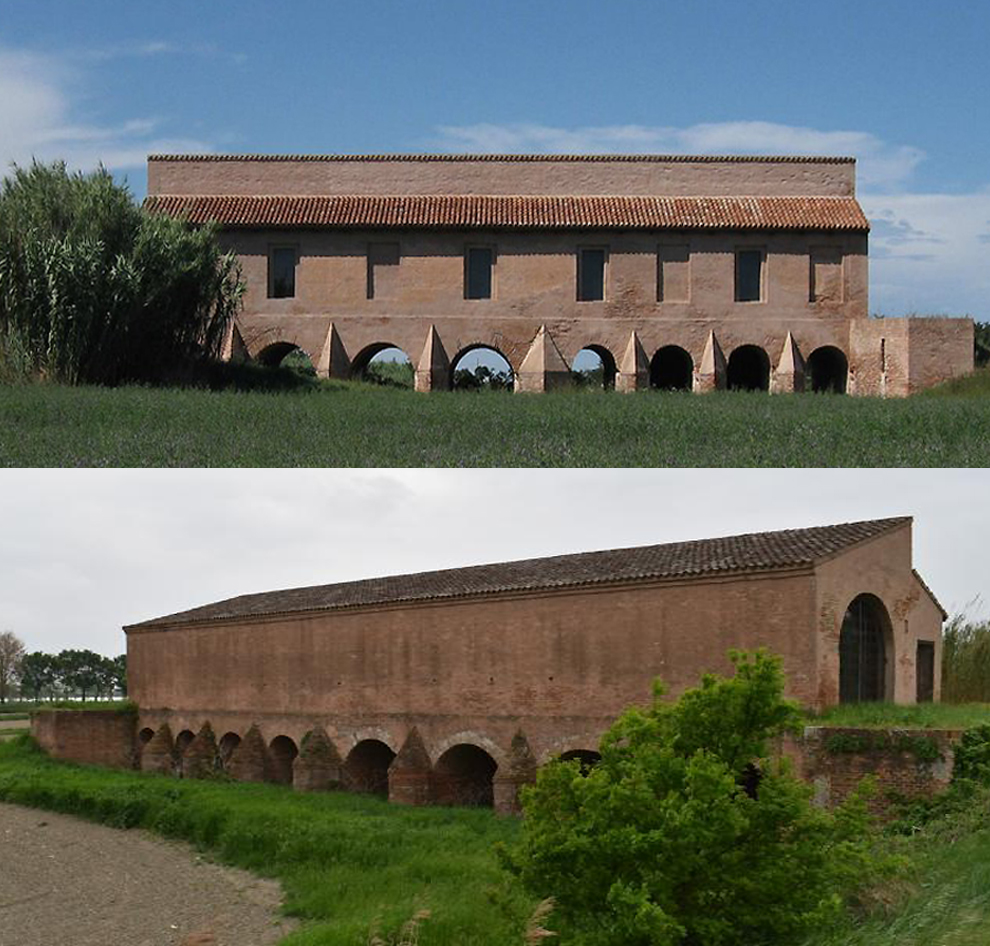
The Agrifoglio drainage ditch
The effects of the great Estense land reclamation were soon nullified by the compaction of the dried peat soils, which caused their lowering, and by the numerous routes of the many watercourses. The territory north of the Po di Volano was redeemed from water only with the advent of mechanical reclamation, which from 1874 onwards, with not always lasting results, completely transformed it.
After the Second World War, the Po Delta Colonisation Board, with the aim of creating new lands to be assigned to small landowners in order to improve the quality of life and contrast the social, economic and cultural degradation, expropriated the dry lands of the latifundia and drained the remaining wetlands; this was followed by the foundation of new rural villages and the creation of a road network and the necessary health and education services.
The main crops grown on the new land included sugar beet and poplar, which were used to produce sugar and paper, for which important industrial plants were built.
In 1883 Francesco Cirio bought some peat lands near Codigoro, between the provincial road and the Po di Volano, from the Società Bonifiche Ferraresi and established the company that took his name. Following the cholera epidemic of 1885, the Società Anonima Agricola Cirio, in order to react to the crisis, decided to build a sugar refinery which was then purchased in 1899 by Giovanni Battista Negrotto, on behalf of the group of Ligurian entrepreneurs who had founded the Eridania Zuccherifici Nazionali; he made an agreement with the Società La Codigoro, owner of the nearby land, to cultivate hundreds of hectares of beet.
In the same year, the factory began operating, not without difficulties due in part to the inexperience of the workers, controversy with La Codigoro and problems with the plant. Production remained loss-making until 1903, and strikes in 1909 forced a temporary closure, but in the following years productivity became such that it reached excess production on several occasions.
The complex, with a huge central building with essential lines, was built using construction techniques that were avant-garde for the time, such as reinforced concrete with large spans and metal reticular structures. During the Fascist period, the building was renovated and a turret was added to the main entrance.
The plant survived the world wars unscathed. The beet processing cycle was interrupted at the end of the 1960s and the complex continued to serve as a storage and distribution facility until 1975. Today, it is in a state of abandonment and degradation, but among the trees and shrubs that have grown spontaneously between the basins and the service buildings of the former sugar refinery, an important garzaia of about 6 hectares has developed, making it a special protection area for fauna. The chimneys are still standing tall.
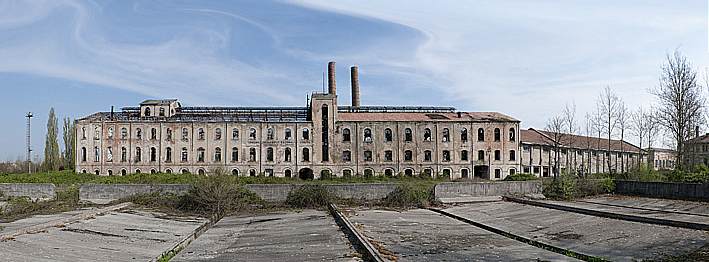
What remains of the sugar factory
Giovanni Battista Negrotto also built the paper mill for the production of cellulose and cardboard in 1902. The plant, strategically located on the Volano river, consisted of an aggregate of functional volumes: the main building, large warehouses, stores, a residential area and a soaring chimney that could be seen from a distance. The paper mill remained in operation until 1972, and the chimney until 1982, when the complex fell into disuse. It has recently been redeveloped to house a large breeding farm for laying hens.
– text by Benedetta Bolognesi ((tenacious cultural explorer) –
– cover shot by Francesco Zaia, the Codigoro sugar refinery in ruins –